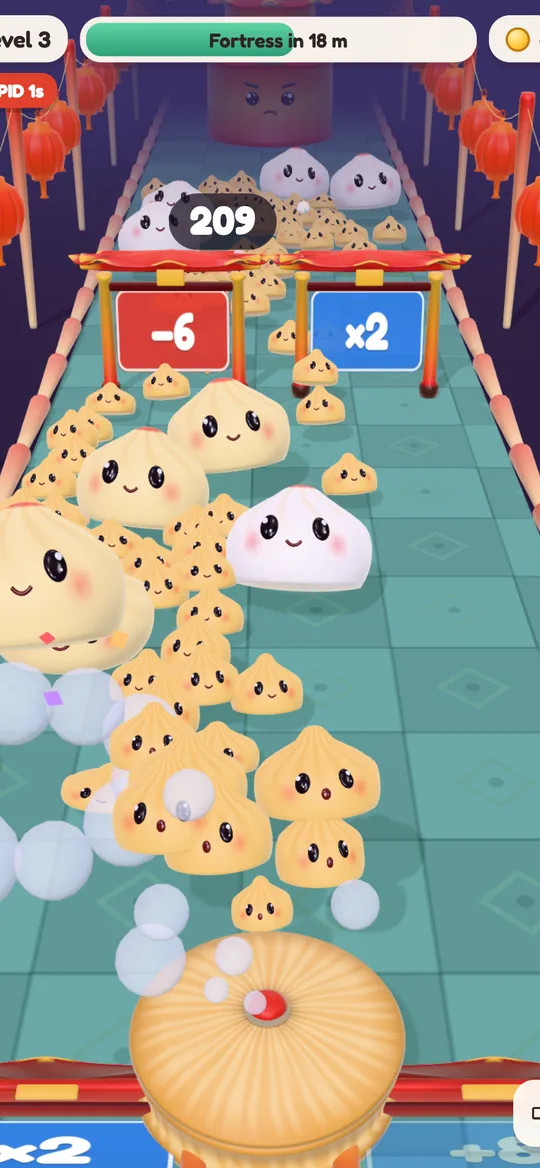
 Dumpling Dash
What is a crowd runner game?
You steer a whole group, not one hero. Here is how the genre works, piece by piece, with real screens from Dumpling Dash.
In this guide
A crowd runner is a casual mobile game where you steer a group of characters down a track instead of a single hero. Gates on the way add to or multiply your group, traps and red gates shrink it, and at the end your crowd fights an enemy, a boss or a wall. The bigger and tighter the crowd you bring to the finish, the better you do.
If you have scrolled past a video of a little army growing from five to five hundred as it runs through glowing gates, you have seen a crowd runner. The idea fits in one sentence, yet there is more going on than it first looks.
So, what is a crowd runner game, exactly? This guide breaks the genre into its parts: the crowd, the gates, the traps, the finish and the progress between levels. The examples come from Dumpling Dash, our own crowd runner with dumplings, so every screen you see here is real.
The one-sentence definition
A crowd runner is a short-level arcade game where you control a group, and the size of that group is your power.
Compare it with a classic runner. There you guide one character, and one mistake usually ends the run. In a crowd runner a mistake costs you a few members of your group, not the whole game. That changes how it feels: you are managing a number that goes up and down all the time, and every choice on the track nudges it one way or the other.
Most crowd runners share the same shape:
- A track that moves toward a finish.
- A crowd that follows your finger.
- Gates that change the crowd's size.
- Hazards that eat into it.
- A final test that uses the crowd you built.
How a crowd runner game works, step by step
Here is what happens in a typical level, using Dumpling Dash as the example.
- Start the crowd. In some games the group is already there. In Dumpling Dash you hold anywhere on the screen and dumplings pop out of a bamboo steamer at the bottom of the street.
- Steer with one finger. Drag left or right and the stream follows. A number above the crowd shows how many you have right now.
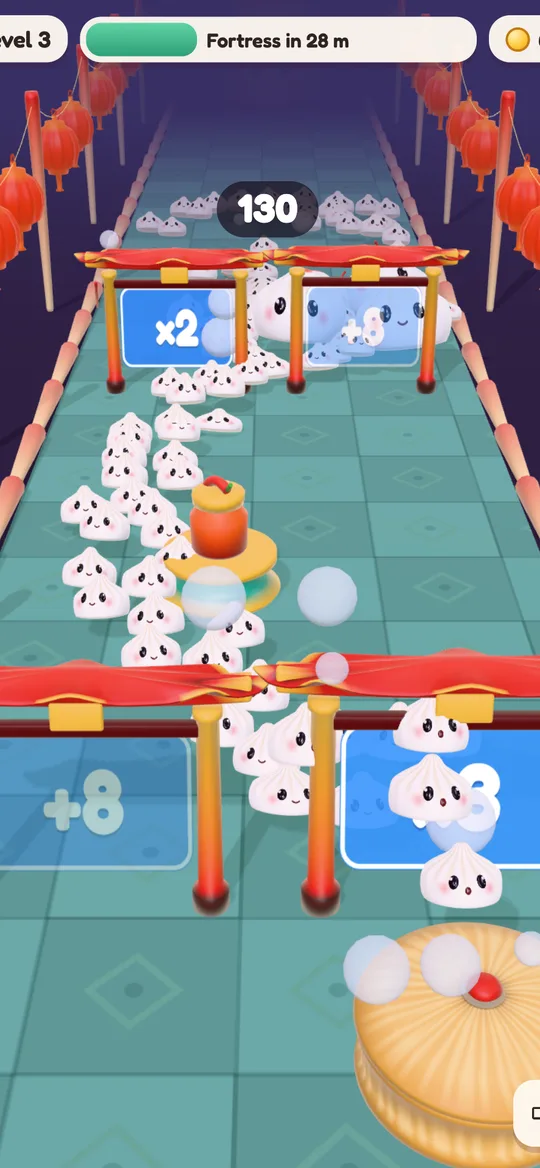
- Choose a gate. Gates come in pairs across the track. Blue ones help (×2, ×3, +8), red ones hurt (−6, ½). You can only take one side.
- Dodge or smash hazards. Obstacles and bad pickups thin the crowd if you run into them carelessly.
- Reach the finish. In Dumpling Dash that is a chopstick fortress guarded by chopstick soldiers. Your dumplings knock it down if they get there in time.
- Collect the reward. Coins from the level go into upgrades that make the next run a little stronger.
A level is short, about a minute in Dumpling Dash, which is why the genre suits a quick break. Our beginner's guide to Dumpling Dash walks through a full level in more detail.
The heart of the genre: maths gates
The gates are what make a crowd runner a crowd runner. Each pair is a tiny sum you solve while moving.
Say your crowd shows 6 and the gates read ×2 and +15. Doubling gives 12, adding gives 21, so the + gate wins. Now say your crowd shows 40. Doubling gives 80, adding gives 55, so the ×2 gate wins. The rule of thumb is add when small, multiply when big.
That is the whole skill in one line, but the game keeps testing it: gates appear fast, sometimes with a pickup or a trap on one side, and you have a second or two to decide. We cover gate choices in depth in our tips for picking the right gate.
Some crowd runners also add twists. In Dumpling Dash, from level 8 there are flip gates that switch between good and bad, so you watch the colour as you get close and pass while it is blue.
Keeping the crowd together
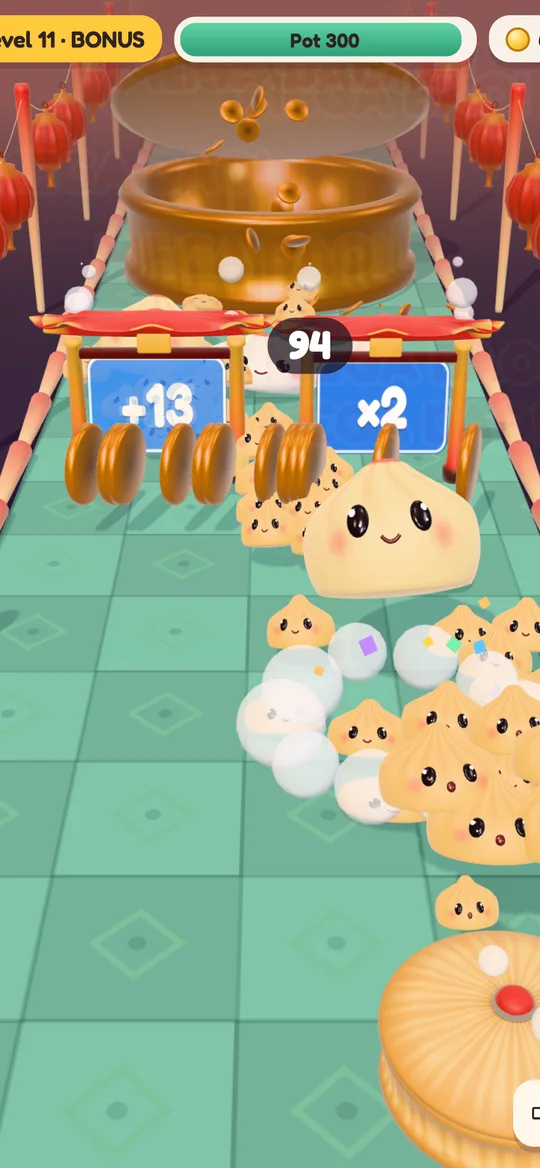
The second skill in the crowd runner genre is shape. A crowd that is spread wide across the track can split between two gates, and half of it may go through the red one.
Good players make small, early moves and then hold still while the crowd passes through. Many games reward a tight group in their own way. In Dumpling Dash, eight dumplings close together squish into a MEGA BAO, a big, tough bun that flattens chopsticks. So a tidy crowd is not just safer; it also hits harder.
Traps, pickups and the final fight
Gates are the main event, but most crowd runners mix in extras to keep levels from feeling the same.
- Obstacles. Dumpling Dash adds a rolling pin from level 6, a spinning Lazy Susan table from level 11 and a noodle wall from level 16.
- Pickups. Good ones help: ginger makes dumplings GIANT, chili oil speeds up steaming and a shield blocks one breach. Bad ones hurt: a wasabi bomb, cold tea that slows you and a tiny spoon that shrinks you. A mystery box can go either way.
- The finish. Every crowd runner needs a moment where the crowd you built is put to use. In Dumpling Dash, chopstick soldiers march toward your steamer while you try to knock the fortress down. If they reach you first, the level ends.
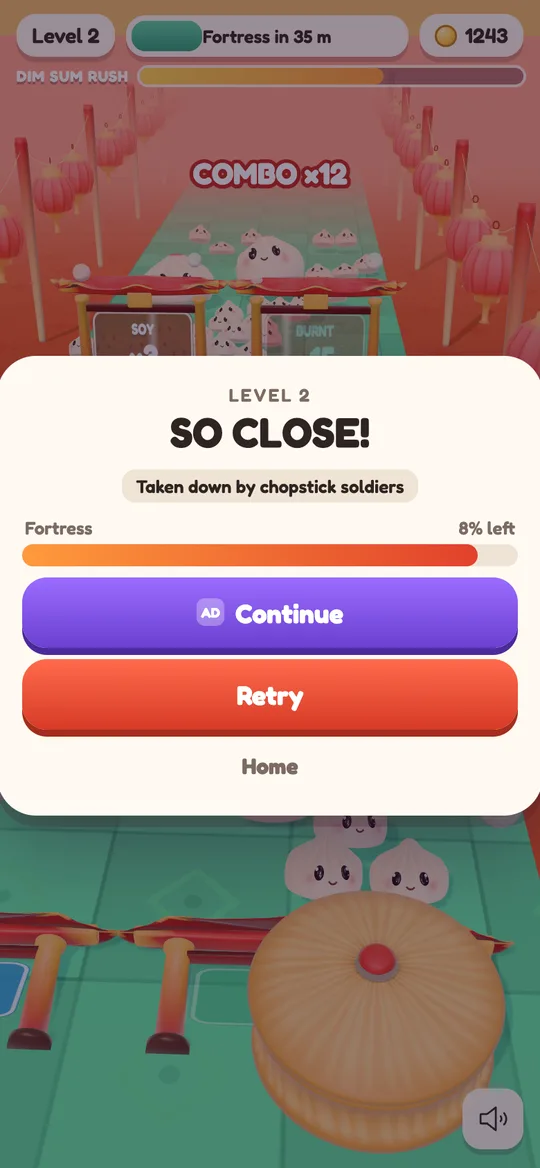
A loss in a crowd runner rarely feels harsh. The result card shows how close you came, the next attempt starts in seconds, and you usually know what to change: a different gate, a tighter crowd or an upgrade.
Progress between levels
What keeps people coming back is the slow climb between levels. Most crowd runners have some mix of:
- Upgrades bought with coins. In Dumpling Dash these are start crowd, fire rate (how fast the steamer works) and squish power (damage).
- A difficulty rhythm. Dumpling Dash makes every 5th level HARD with more coins and puts a boss on every 10th, like the Giant Fork or the Wok Golem. After each spike comes an easier level or a dumpling rain bonus level.
- Things to collect. Skins are a common one. Dumpling Dash starts you with a Xiaolongbao (here is what a xiaolongbao is in real life) and lets you fill a skin bar to unlock Gyoza, Rainbow Bao and the legendary Golden Bao.
Is it the same as an endless runner?
Not quite. An endless runner keeps going until you crash, and the goal is distance or score. A crowd runner has short levels with a clear finish, and the goal is to arrive with as much power as possible. The swiping feels similar, but the thinking is different: a crowd runner is more about small sums and timing than about reflexes alone.
Who are crowd runner games for?
The genre suits anyone who wants a game they can pick up for a minute and put down again. The controls are one finger, the rules show up on screen as you play, and the numbers make it easy to see why you won or lost.
For younger players, the colour coding helps a lot: blue is good, red is bad. Grown-ups who want to check what a game does with ads, purchases and data can read our parents' guide to Dumpling Dash, which covers all of that in plain words.
FAQ
What is the goal of a crowd runner game?
The goal is to reach the end of each level with the biggest, strongest crowd you can, then use it to win the final test, such as knocking down a fortress or beating a boss.
Why are the gates maths sums?
The gates turn every choice into a quick sum: add or multiply. That small bit of thinking is what separates a crowd runner from a pure reflex game, and it is easy for anyone to learn.
Are crowd runners hard?
Early levels are gentle, and difficulty rises in steps. In Dumpling Dash every 5th level is HARD and every 10th has a boss, but each spike is followed by an easier level or a bonus level.
Do crowd runner games need the internet?
It depends on the game. Dumpling Dash plays offline; an internet connection is only used for ads.
How long is a level?
Levels in most crowd runners are short. In Dumpling Dash a level takes about a minute, which makes it easy to stop at a natural point.