 Dumpling Dash
What is xiaolongbao? Meet the soup dumpling
A little dumpling with hot soup hiding inside. Here is what it is, how it works and how to eat one without a splash.
In this guide
Xiaolongbao are small steamed Chinese dumplings with a thin, pleated wrapper and a filling of seasoned meat plus hot soup. The soup starts as a jelly made from broth, which melts when the dumplings are steamed. They are best known from Shanghai, the name means roughly "little basket bun", and they are eaten carefully from a spoon because the soup inside is very hot.
Pick one up, and it wobbles. Bite in too fast, and you get a splash of hot soup. That surprise is the whole charm of the xiaolongbao, the little dumpling that is also the very first character you play with in Dumpling Dash.
If you have seen xiaolongbao on a menu and wondered what you were looking at, this guide is for you. We cover what the name means, how the soup gets inside a closed dumpling, how to eat one without burning your tongue, and how the real food shaped the cute crowd in our game.
What is xiaolongbao, in plain words?
A xiaolongbao is a small steamed dumpling. Three things make it special:
- A thin wrapper. The dough is rolled thin, then gathered at the top into lots of small pleats that twist together into a little knot.
- A savoury filling. Pork is the classic choice. Pork with crab is a popular extra-fancy version, and many places also make vegetable ones.
- Soup inside. This is the part people talk about. Each one holds a spoonful of hot broth around the filling.
In English they are often just called soup dumplings. They are cooked in round bamboo baskets and usually brought to the table in the same basket, still steaming.
What does the name mean?
The name comes from Chinese, 小笼包, and it breaks into three parts:
- xiao means small or little,
- long means a basket, here the bamboo steaming basket,
- bao means a bun or a filled dough parcel.
So xiaolongbao is roughly "little basket bun". The name tells you how the dish is cooked rather than what is inside it, which is a nice clue that the basket matters. You may also see it written as xiao long bao, or shortened to XLB.
Xiaolongbao are best known from Shanghai, and their story is usually linked to Nanxiang, a town that is now part of the city. Today you can find them in dumpling houses all over the world.
How does the soup get inside?
This is the clever bit, and it makes a great question to puzzle over with a curious kid. You cannot pour soup into a dumpling and then close it, because the soup would run everywhere. So cooks use a trick:
- Make a rich broth. Cooks simmer a stock until it is full of flavour.
- Let it set. When the stock cools, it turns into a soft jelly, a bit like a savoury jelly dessert.
- Chop the jelly. The set jelly is cut into small cubes.
- Mix it into the filling. The cubes are stirred into the meat, so the filling is still firm enough to wrap.
- Wrap and pleat. A spoonful of filling goes in the middle of a thin wrapper, and the edges are pleated and twisted shut at the top.
- Steam. In the bamboo basket the heat melts the jelly back into soup, and the soup stays sealed inside.
That is why a good xiaolongbao looks a little saggy in the basket: the soup inside makes it heavy and soft.

How to eat xiaolongbao without a splash
The soup inside is very hot, so take it slowly. Younger children should eat them with a grown-up who can check that each one has cooled enough. Here is the usual way:
- Wait a moment. Let the basket sit for a little while after it arrives, so the soup is not scalding.
- Lift gently. Pick the dumpling up by the knot at the top with chopsticks, not by the soft sides, which tear easily.
- Use a spoon. Set it in a soup spoon so nothing is lost if it breaks.
- Make a small opening. Nibble a tiny hole in the side and let the steam out.
- Sip the soup. Drink the soup from the hole, a little at a time.
- Eat the rest. Dip the dumpling in a little black vinegar with thin strips of ginger if you like, and eat it in one or two bites.
Xiaolongbao vs other dumplings
Xiaolongbao are often mixed up with other steamed favourites. A quick way to tell them apart:
- Xiaolongbao: small, thin skin, pleated top, soup inside, steamed.
- Bao (such as char siu bao): bigger, with a soft, fluffy bread-like dough. No soup.
- Gyoza: a half-moon dumpling, usually pan-fried until the bottom is crisp and golden. No soup.
All three turn up in Dumpling Dash as skins, so playing is an easy way to spot the shapes.
Why xiaolongbao is our starter dumpling
When we designed Dumpling Dash, we wanted a hero that is cute, round and instantly readable on a small screen, in a crowd of over a hundred. The xiaolongbao was perfect: its twisted top gives every character a little tuft, and its round body squishes nicely when eight of them merge into a big MEGA BAO.
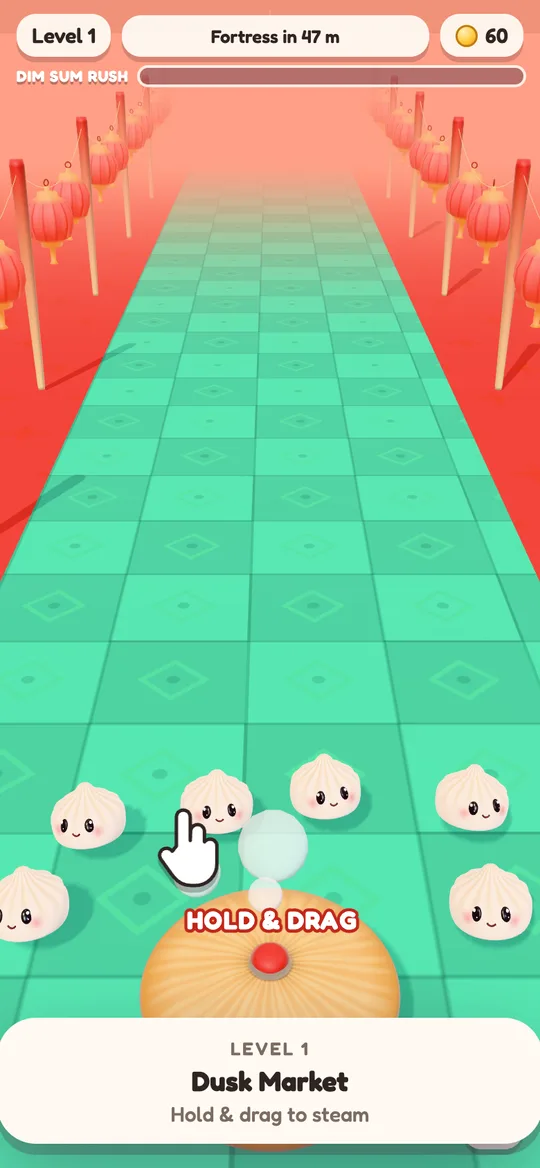
It also explains the steamer. In the game you hold anywhere on the screen and dumplings pop out of a bamboo steamer at the bottom of the street, just like a basket of xiaolongbao arriving at the table. If you have not played yet, our beginner's guide to Dumpling Dash shows a full level from start to finish.
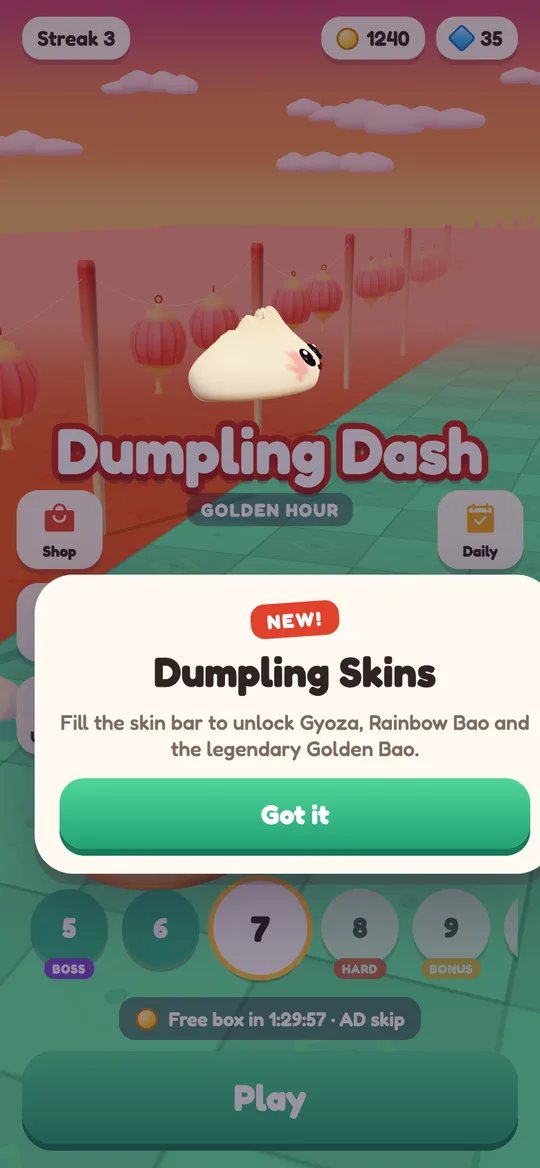
Xiaolongbao is the skin every player starts with. As you win levels, a skin bar fills up, and each time it is full you unlock the next dumpling in line: Gyoza, then Rainbow Bao, then the legendary Golden Bao. You can switch back to the classic any time from the Skins tab in the Shop. Everything in the game is earned by playing, with no purchases.
If you are new to games where you steer a whole group instead of one hero, our explainer on what a crowd runner game is covers how the gates, the crowd and the final fight fit together.
A fun dumpling question to try at home
Next time you are in the kitchen with an adult, try the jelly part of the trick on its own. Put some cooled homemade stock in the fridge overnight and see whether it sets. If it wobbles in the morning, you have found the secret behind the soup dumpling, no wrapping needed.
FAQ
What is xiaolongbao made of?
A thin wheat-flour wrapper around a savoury filling, most often pork, sometimes pork with crab or vegetables, mixed with set broth that melts into soup when the dumplings are steamed.
Why is it called a soup dumpling?
Because each dumpling holds hot soup around the filling. The soup starts as a jelly made from stock and turns back into liquid in the steamer.
Is xiaolongbao the same as bao?
No. Bao usually means a bigger bun with a soft, fluffy, bread-like dough and no soup. Xiaolongbao are smaller, have a thinner skin and are filled with soup.
How should kids eat xiaolongbao?
With a grown-up nearby. Let the dumplings cool for a moment, put one on a spoon, nibble a small hole, sip the soup slowly, then eat the rest.
Which skin is the xiaolongbao in Dumpling Dash?
It is the starter skin that every player begins with. Filling the skin bar by winning levels unlocks Gyoza, Rainbow Bao and the legendary Golden Bao after it.